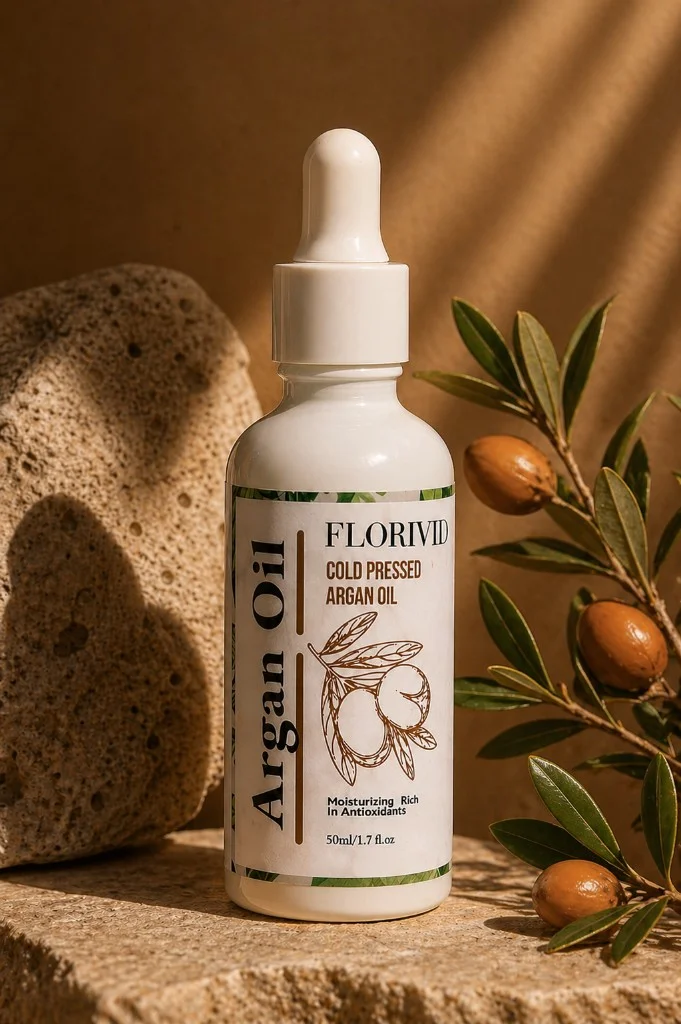
The Complete Guide
What is argan oil?
Everything you should know about the most studied plant oil in skincare — from the tree, to the press, to your skin — written by the people who make it.
- 99.7%
- Purity
- 620 mg/kg
- Polyphenols
- 25%
- More vitamin E vs. standard
- 48
- Women in our cooperative
01 — What is argan oil
Liquid gold from a single valley.
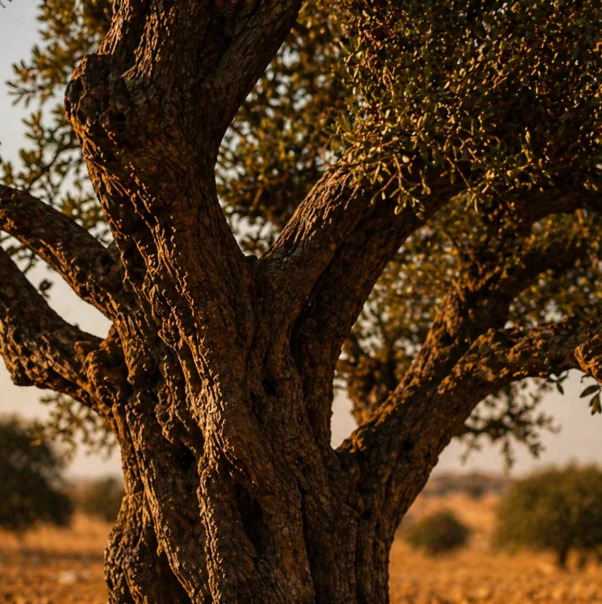
Argan oil is a plant-based oil pressed from the kernels of the Argania Spinosa tree — a species found almost exclusively in the Souss-Massa region of southwestern Morocco. The tree is ancient; the practice of pressing its kernels for oil is older still, documented for at least nine centuries.
The kernel contains roughly 50% oil by weight. That oil is composed primarily of oleic acid (43–49%), linoleic acid (29–36%), and a concentrated fraction of tocopherols — vitamin E — that gives it both its golden colour and its antioxidant power.
What makes cold-pressed argan oil exceptional is not any single compound, but the intact ratio of all of them. Industrial heat processing destroys polyphenols and oxidises fatty acids. Cold-press — at temperatures below 30°C — preserves the molecule as nature assembled it.
02 — Proven benefits
What argan oil actually does to your skin.
01
Restores the lipid barrier
Oleic and linoleic acids mirror the skin's own natural lipids. They slot into gaps in the stratum corneum, reducing transepidermal water loss and visibly plumping dehydrated skin within days.
02
Antioxidant protection
620 mg/kg polyphenols and 62 mg/100g tocopherols neutralise free radicals from UV and pollution. Regular use has been shown in clinical studies to reduce oxidative stress markers measurably.
03
Reduces fine lines
A 2015 randomised trial (Boucetta et al.) found significant improvement in skin elasticity after 60 days of argan oil application. The mechanism is both barrier restoration and squalene-driven collagen support.
04
Non-comedogenic
Argan oil has a comedogenic rating of 0. Its linoleic acid content — lacking in oily skin — may actively reduce sebum excess. It is one of the few oils suitable for acne-prone and oily skin types.
05
Seals and shines hair
Applied to hair, argan oil's fatty acids form a protective coating around the cuticle, reducing porosity, breakage, and frizz. It adds shine without silicone — the luminosity is structural, not cosmetic.
06
Soothes inflammation
Triterpenoids in argan oil inhibit pro-inflammatory cytokines. This makes it effective for calming redness, rosacea-adjacent sensitivity, and dry, reactive skin. Results are typically visible within two weeks.
03 — How it's made
Forty-eight hours from harvest to bottle.
Most argan oil is pressed weeks after harvest, at elevated temperature, using solvent. Ours is pressed within 48 hours, cold, by the cooperative that grew it.
Souss Valley, Morocco
The Argania Spinosa fruits are gathered by hand from our 12-hectare cooperative. Only ripe fruit yields oil with the polyphenol concentration we publish.

First cold-press
Kernels are cold-pressed within 48 hours of harvest at 28°C. Lower temperature means a slower yield — and an intact molecule. No solvents, no heat.

Lab-verified purity
Every batch is tested before bottling. We publish the results: 99.7% purity, 620 mg/kg polyphenols. The numbers are available on request.
04 — How to use it
Three rituals, one bottle.
Method 01
On the face
- 01Warm 2–3 drops between clean palms.
- 02Press into damp skin after toner or mist.
- 03Morning or evening — under SPF or alone.
Method 02
On the body
- 01Apply to still-damp skin after the shower.
- 02Concentrate on knees, elbows, ankles.
- 03Massage until absorbed — 30 seconds.
Method 03
On the hair
- 01Smooth one drop through mid-lengths and ends.
- 02Use on damp hair to seal, or dry hair to tame.
- 03Do not rinse. Style as usual.
05 — Argan oil vs. other oils
How it compares to coconut, rosehip, and jojoba.
| Property | Argan oil | Coconut oil | Rosehip oil | Jojoba oil |
|---|---|---|---|---|
| Comedogenic rating | 0 — safe for all | 4 — clogs pores | 1 — low risk | 2 — low risk |
| Main fatty acid | Oleic + Linoleic | Lauric acid | Linoleic acid | Eicosenoic acid |
| Vitamin E content | 62 mg/100g | Trace | Low | Low |
| Best for skin type | All — inc. oily | Dry, not oily | Ageing, dry | All |
| Hair use | Excellent — seals cuticle | Heavy, can build up | Not typical | Light conditioner |
| Absorption speed | Fast — non-greasy | Slow — occlusive | Medium | Fast |
| Scent | Faint nutty, fades | Strong coconut | Earthy | Nearly scentless |
| Stability (shelf life) | 18–24 months | 24+ months | 6–12 months | 24+ months |
Comedogenic ratings sourced from peer-reviewed dermatology literature. Fatty acid profiles based on published INCI data.
06 — Frequently asked questions
Everything else you want to know.
What is argan oil?
Argan oil is a plant-based oil pressed from the kernels of the Argania Spinosa tree, native to the Souss Valley of Morocco. It is rich in oleic acid, linoleic acid, and vitamin E (tocopherols), making it one of the most effective natural oils for skin and hair care.
What are the benefits of argan oil for skin?
Argan oil restores the skin's lipid barrier, reduces the appearance of fine lines, softens dry patches, and delivers antioxidant protection via vitamin E. Cold-pressed argan oil retains the highest concentration of active compounds. Clinical studies show measurable improvements in elasticity after 60 days.
What is the difference between cold-pressed and refined argan oil?
Cold-pressed argan oil is extracted mechanically at low temperature (below 30°C), preserving its polyphenols, tocopherols, and fatty acids. Refined argan oil is processed with heat or chemicals, destroying many active compounds and producing a less effective product at a lower production cost.
Can argan oil be used on hair?
Yes. Argan oil seals the hair cuticle, reduces frizz and breakage, and adds shine. Applied to damp hair it acts as a leave-in treatment. On dry hair it tames fly-aways and adds luminosity without weighing hair down. One drop is enough for mid-lengths to ends.
Is argan oil good for acne-prone skin?
Argan oil has a comedogenic rating of 0, meaning it is unlikely to clog pores. Its linoleic acid content can help regulate sebum production in oily skin. Pure, cold-pressed argan oil is generally suitable for oily and combination skin types.
How much argan oil should I use?
For the face: 2–3 drops warmed between palms, pressed into damp skin. For the body: 5–8 drops massaged into damp skin after the shower. For hair: 1–2 drops through mid-lengths and ends. Argan oil is concentrated — more is not better.
How is Florivid argan oil different from other brands?
Florivid argan oil is single-origin, first cold-press, sourced from a 12-hectare cooperative of 48 women in the Souss Valley. We publish our lab analysis: 99.7% purity and 620 mg/kg polyphenols — 25% higher than industry standard. Nothing added, nothing removed. The numbers are available on request.
Ready to begin
The oil we've described. Nothing more.
50 ml. Cold-pressed. Single-origin Souss Valley. No additives, no dilution. Tested and published.